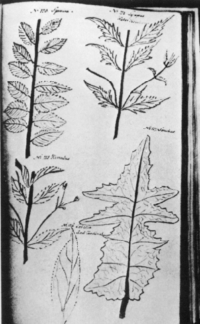
Jane Colden botanical drawings, public domain, via Wikimedia Commons.
The Hudson Valley is filled with stories of revolutionaries, politicians, artists, industrialists, and prominent families. But one of the region’s most remarkable historical figures spent much of her life studying something far quieter: the plants growing around her Orange County home. Her name was Jane Colden, and today she is widely recognized as America’s first female botanist.
Born in New York City in 1724, Colden grew up at her family’s estate, Coldenham, located west of present-day Newburgh in Orange County. There, in the mid-18th century, she began documenting the Hudson Valley’s wild plants with a level of scientific care that earned the respect of some of the leading botanists of her time. Yet despite the importance of her work, her name largely disappeared from scientific history for more than a century.
Growing Up at Coldenham in Orange County
Jane was the daughter of Cadwallader Colden, a physician, scientist, landowner, and prominent colonial official who eventually served as lieutenant governor of the Province of New York. The Colden family estate offered Jane something extraordinary: access to both the Hudson Valley’s natural landscape and the intellectual world of colonial science.
Her father had a serious interest in botany himself and introduced Jane to the revolutionary plant-classification system developed by Swedish naturalist Carl Linnaeus. There was an obstacle, however. Scientific works of the period were commonly written in Latin, a language women generally were not taught. Cadwallader Colden therefore translated portions of Linnaeus’s Genera Plantarum into English so his daughter could study the system. Jane took it from there.
Studying the Wild Plants of the Hudson Valley
From roughly 1753 to 1758, Jane Colden studied the plants around Coldenham. She wasn’t merely compiling a list of wildflowers. She carefully examined plants, described their characteristics, classified them using the Linnaean system, and created illustrations to accompany many of her observations.
Her surviving botanical manuscript contains descriptions and illustrations of more than 300 plants from the Province of New York. The New York Botanical Garden notes that she compiled original descriptions and illustrations for 341 plants from the Coldenham region.
Imagine what that work required in the 1750s. No field guides were tucked into backpacks, no phone cameras recorded specimens, and certainly no plant-identification apps. Instead, Colden explored the landscape surrounding her Orange County home, observing the shapes of leaves, flowers, stems, and reproductive structures, then recording those details by hand.
Her work offers an extraordinary scientific window into the natural environment of the colonial Hudson Valley.
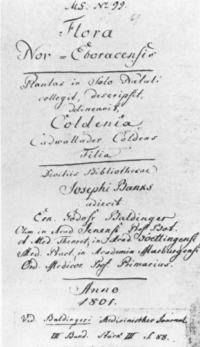
Title page of Jane Colden’s botanical manuscript, public domain, via Wikimedia Commons.
Jane Colden and the Scientific Community
Jane Colden was notable not only for studying plants but also for being known to respected scientists. Several prominent botanists and naturalists of the period visited Coldenham, including John and William Bartram, Peter Kalm, and Alexander Garden. Sweetgum
Her abilities also earned praise overseas. In 1758, English botanist and merchant Peter Collinson wrote to Linnaeus about Colden. He praised her remarkable command of the Linnaean system and urged that her scientific abilities be recognized. For a woman pursuing scientific work in colonial America, such recognition was remarkable.
A Plant She Tried to Name Gardenia
One particularly interesting chapter in Colden’s career involved a plant she believed deserved recognition as a distinct genus.
She proposed naming it Gardenia, honoring her friend and fellow botanist Alexander Garden.
There was a problem. The name Gardenia had already been assigned to another genus—the fragrant flowering plant we still know by that name today. Colden’s proposed name therefore couldn’t stand. Linnaeus subsequently described the plant as Hypericum virginicum.
The episode demonstrates something important about Colden. She wasn’t simply copying information from her father or other scientists. She observed plants, evaluated their characteristics, and made her own botanical judgments.
Why Don’t More People Know Jane Colden?
Jane Colden had completed much of her botanical research by 1758, but her work was never published as a conventional scientific book during her lifetime. Her manuscript was preserved and eventually entered collections now associated with London’s Natural History Museum, though portions were not published until much later.
In 1759, Jane married Scottish physician William Farquhar. She died in 1766 after childbirth, at just 41, and her botanical accomplishments gradually faded from public awareness.
Interest in Colden’s work returned more than a century later, when British botanist James Britten published an account of her life and botanical work in 1895. New York Botanical Garden
Today, historians and botanists increasingly recognize Colden as an important figure in women’s history and in the development of American science.
Jane Colden’s Hudson Valley Legacy
Perhaps the most compelling aspect of Jane Colden’s story is how deeply it is rooted in the Hudson Valley landscape.
The plants she examined weren’t specimens brought home from distant expeditions. They were the trees, shrubs, flowers, and herbs growing in 18th-century Orange County. The same landscape she explored still surrounds communities such as Newburgh, Montgomery, New Windsor, and other parts of the mid-Hudson Valley.
Her story is therefore more than a chapter in botanical history. It is Hudson Valley history. A physical connection to her legacy remains in Orange County. In 1957, the Jane Colden Memorial Garden was established at Knox’s Headquarters State Historic Site in New Windsor. According to the New-York Historical Society’s Women & the American Story project, the garden was planted with species Colden studied and recorded in her manuscript.
A Hudson Valley Pioneer Worth Remembering
Jane Colden lived in an era when women had few opportunities to participate formally in science.
Nevertheless, from a family estate in Orange County, she studied hundreds of plants, mastered one of the newest scientific classification systems in the world, and earned the admiration of internationally connected botanists. Nearly three centuries later, the plants she studied still grow throughout the Hudson Valley.
Her story reminds us that some of the region’s most important historical figures aren’t necessarily found on monuments or in the most familiar history books. Sometimes they’re found in an old manuscript—and in the wildflowers growing along a Hudson Valley trail.
Can you visit a place connected to Jane Colden today?
The Jane Colden Memorial Garden was established at Knox’s Headquarters State Historic Site in New Windsor, New York. It features plants representing species Colden studied.
Colden Mansion Ruins: Built in 1767 by Cadwallader Colden Jr., this luxurious 17-room stone mansion once anchored the family farm. Today, its ruins lie in the woods near the intersection of Route 17K and Stone Castle Road. The Town of Montgomery has actively sponsored archaeological and interpretive studies to preserve the site as parkland.
The Sojourner