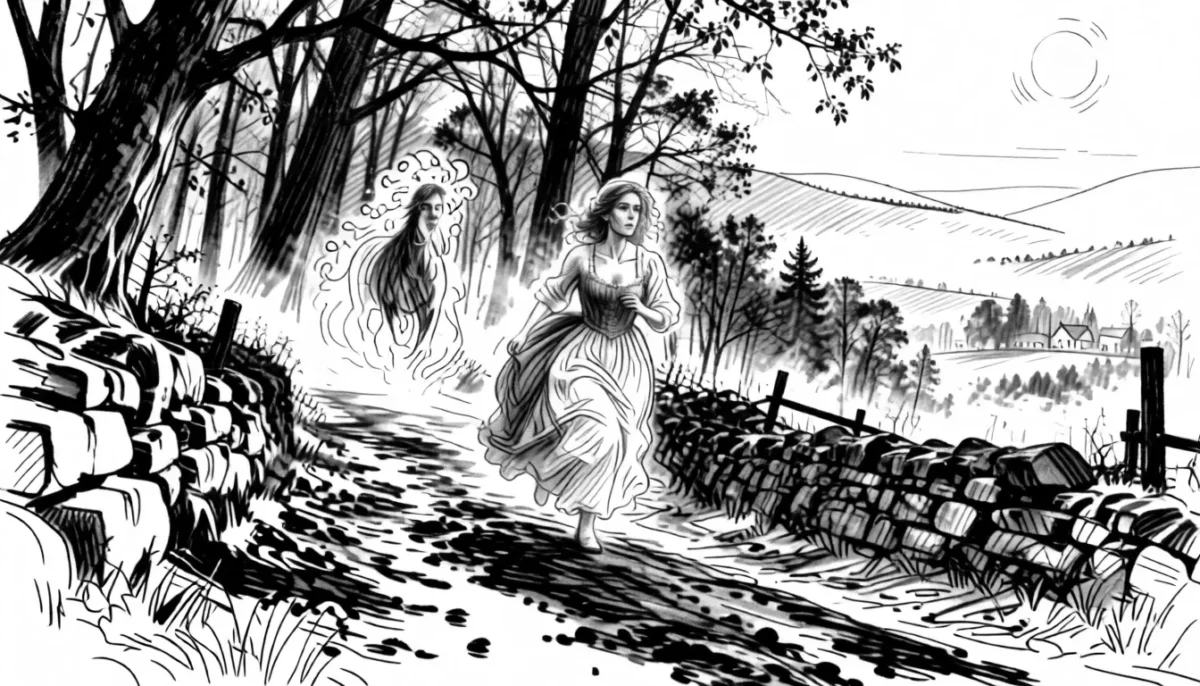
In places in the Catskills, darkness seems to settle differently. The woods grow quieter, the roads narrow beneath the trees, and old stone walls appear and vanish in the headlights. Near Leeds in Greene County, New York, one ghost story has endured for generations: the legend of a murdered servant girl whose spirit is said to still haunt the countryside.
According to local folklore, the story dates back to colonial-era Greene County, when Leeds was surrounded by farms, rough roads, deep woods, and isolated homes. One of the most familiar versions identifies the young servant as Anna Dorothea Swarts, who worked in the household of a wealthy landowner named William Salisbury. Accounts differ on some details, including Anna’s background and the exact date of the tragedy, but the central story remains chillingly consistent.
Anna tried to run away.
Her master pursued her, caught her along the road, and, according to legend, tied her to his horse. The animal was then driven forward, dragging the young woman behind it until she died. Whether every detail of that account can be proven historically is uncertain, but the story became deeply rooted in local folklore.
Soon after her death, strange tales began to circulate. Travelers passing through the area after dark reportedly heard hoofbeats approaching from behind, even when the road was empty. The sound would begin faintly, then grow louder and faster, as though an unseen horse were gaining ground.
Some witnesses claimed to hear a woman screaming along with the pounding hooves. Others described seeing a spectral horse racing through the darkness, sometimes with the apparition of a woman dragged behind it. In certain versions of the story, a skeletal figure appears as well, transforming the haunting into something almost nightmarish.
The apparition became associated with places remembered in local storytelling as Spooky Hollow and Spook Rock. In the days before electric lights and paved roads, it is easy to understand how terrifying such a story would have been. Imagine traveling alone through the woods by lantern light, hearing hoofbeats behind you, urging your own horse faster, only to realize that the unseen rider was keeping pace.
The legend also suggests that Salisbury escaped serious punishment for Anna’s death. Some retellings claim his wealth or influence protected him, while another strange variation says he was forced to wear a noose around his neck for the rest of his life. These details are difficult to separate from folklore, but they add an important theme to the story: a violent death for which justice may never have been fully served.
Perhaps that is why Anna’s ghost was said to return.
Not every version of the haunting involves screaming or phantom horses. Some stories describe a quieter apparition: a young woman sitting near an old wall by the road. Travelers would see her in the darkness, pass by, then look back to find she had vanished without a sound.
The servant girl’s identity also varies by storyteller. Over the years, she has been described as Scottish, German, Native American, Spanish, or connected to Hessian soldiers from the Revolutionary period. These shifting details are part of what makes the legend so compelling. The history blurs, but the emotional core remains the same: a powerless young woman tries to escape, suffers a violent death, and returns as something that refuses to be forgotten.
Local lore has long associated the haunting with Salisbury Manor in Leeds. Stories connected with the property include mysterious screams, sightings of a young woman, and the enormous phantom horse linked to Anna’s death. The property is privately owned, however, and should be respected as such.
Today, Leeds is far different from the isolated settlement it once was, but the surrounding countryside can still feel remarkably lonely after dark. On a cold autumn night, with the windows cracked and the radio off, it is not difficult to imagine how the legend has survived for so long.
The woods go quiet. The road stretches empty behind you. Then you hear it.
A hoofbeat.
Then another.
You check the rearview mirror, but there is nothing there.
Still, the sound keeps coming closer.
Nearly three centuries may have passed since the events that inspired the legend of the Servant Girl of Leeds, but the story has never entirely disappeared. Details have changed, names have shifted, and history has blended with folklore, yet the image remains the same: a frightened young woman desperately trying to escape, pursued through the darkness.
According to the old stories, she is still running.
So if you ever find yourself alone on a back road near Leeds late at night and hear hoofbeats approaching from behind, you may want to keep driving.
Whatever you do, don’t stop.
The Sojourner